Cascades
|
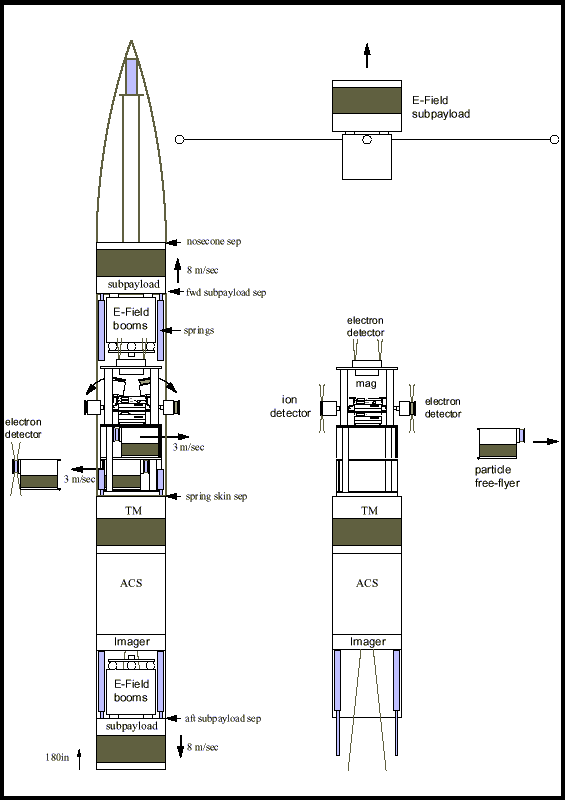
The purpose of the Cascades (THE CHANGING AURORA: IN SITU AND CAMERA ANALYSES OF DYNAMIC ELECTRON PRECIPITATION STRUCTURES) sounding rocket mission is the investigation of motions and structure of electron precipitation in pre-midnight poleward edge discrete aurora. Our principal scientific objective is the investigation of spatial and temporal structures within electron precipitation and low-frequency electric field activity in the topside ionosphere. Multiple-payload sounding rocket technology together with GPS position and timing information and modern, dedicated ground observations will allow unprecedented simultaneous quantification of a number of important auroral phenomena within a given auroral event. The experiment consists of a main payload and four subpayloads. The payload's 100 km magnetic footpoint will be tracked in real time by a dedicated ground-based narrow-field auroral camera from Kaktovik, and these images together with those from all-sky cameras and from an onboard, field-aligned camera (developed by MIRL) will provide the auroral context for the in situ plasma measurements. The sounding rocket will be launched from the Poker Flat Research Range in winter 2005. The MIRL, with funding through the Geospace SR&T program (M. Lessard, PI), is responsible for the development of a new technique (DERBI) to enable a certain auroral imager to be used on auroral sounding rockets. The basic imager design is based on low-light television camera technology, which is well developed and relatively inexpensive. Adaptation of this type of camera for a mission such as Cascades introduces a few issues that will be addressed by the lab, including sensitivity, spatial resolution, signal-to-noise ratio, image blurring, and image despinning. The first flight of this instrument was aboard the SERSIO sounding rocket (P. Kintner, PI), launched in January, 2004. More information about Cascades (K. Lynch, PI, Dartmouth College) |