SERSIO
|
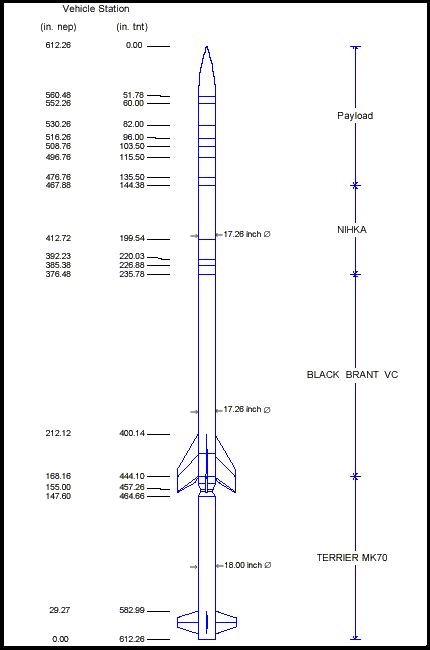
The purpose of the SERSIO (Svalbard EISCAT Rocket Study of Ion Outflows) sounding rocket mission is to investigate ion outflows between 600 and 800 km altitude in the polar cusp/cleft with a sounding rocket experiment and the EISCAT Svalbard radar (ESR) and the EISCAT Tromso radar. The ESR and Tromso radars will be used to monitor ion outflow near the nominal rocket apogee for comparison with the sounding rocket data and to determine the launch conditions. The sounding rocket experiment will measure ion drifts, electron drifts, electron and ion precipitation, convection electric fields, and plasma waves. The objectives of the experiment are to determine the physical mechanism responsible for the ionospheric outflow, the source of free energy for the outflows, and to investigate the relationship of the ion outflows to previous satellite measurements of vertical ion drifts and sounding rocket measurements of transverse ion acceleration at higher altitudes in the polar cusp/cleft. The 35.035 UE/Kintner payload for the SERSIO mission is based on the design of 40.014 flown successfully in January 2002 from Poker Flat Research Range in Fairbanks, Alaska (P. Kintner, PI). The MIRL, with funding through the Geospace SR&T program (M. Lessard, PI), is responsible for the development of a new technique (DERBI) to enable a certain auroral imager to be used on auroral sounding rockets. The basic imager design is based on low-light television camera technology, which is well developed and relatively inexpensive. Adaptation of this type of camera for a mission such as SERSIO introduces a few issues that will be addressed by the lab, including sensitivity, spatial resolution, signal-to-noise ratio, image blurring, and image despinning. This instrument will also be sent aboard the Cascades sounding rocket (K. Lynch, PI) scheduled for launch from the Poker Flat Research Range in winter 2005. More information about SERSIO (K. Lynch, Dartmouth College) |